

Healthcare Innovation & Medical Advances
The Hidden Carbon Footprint of Surgery: How Greener Anaesthesia Is Transforming Healthcare
PRIME

Modern anaesthesia combines patient safety with more environmentally sustainable clinical practices.
Few realise that every operation also has an environmental footprint.
From electricity and disposable medical supplies to sterilisation processes and anaesthetic gases, healthcare is surprisingly energy intensive. In fact, hospitals around the world are increasingly examining how they can reduce carbon emissions without compromising patient care.
One area receiving growing attention is anaesthesia—the medications and gases that keep patients comfortable and pain-free during surgery.
Recently, Changi General Hospital (CGH) became Singapore’s first hospital to completely eliminate the use of desflurane, a commonly used anaesthetic gas with a particularly high environmental impact. The milestone reflects a broader international movement towards making healthcare more sustainable while maintaining the same high standards of patient safety.
Why does anaesthesia affect the environment?
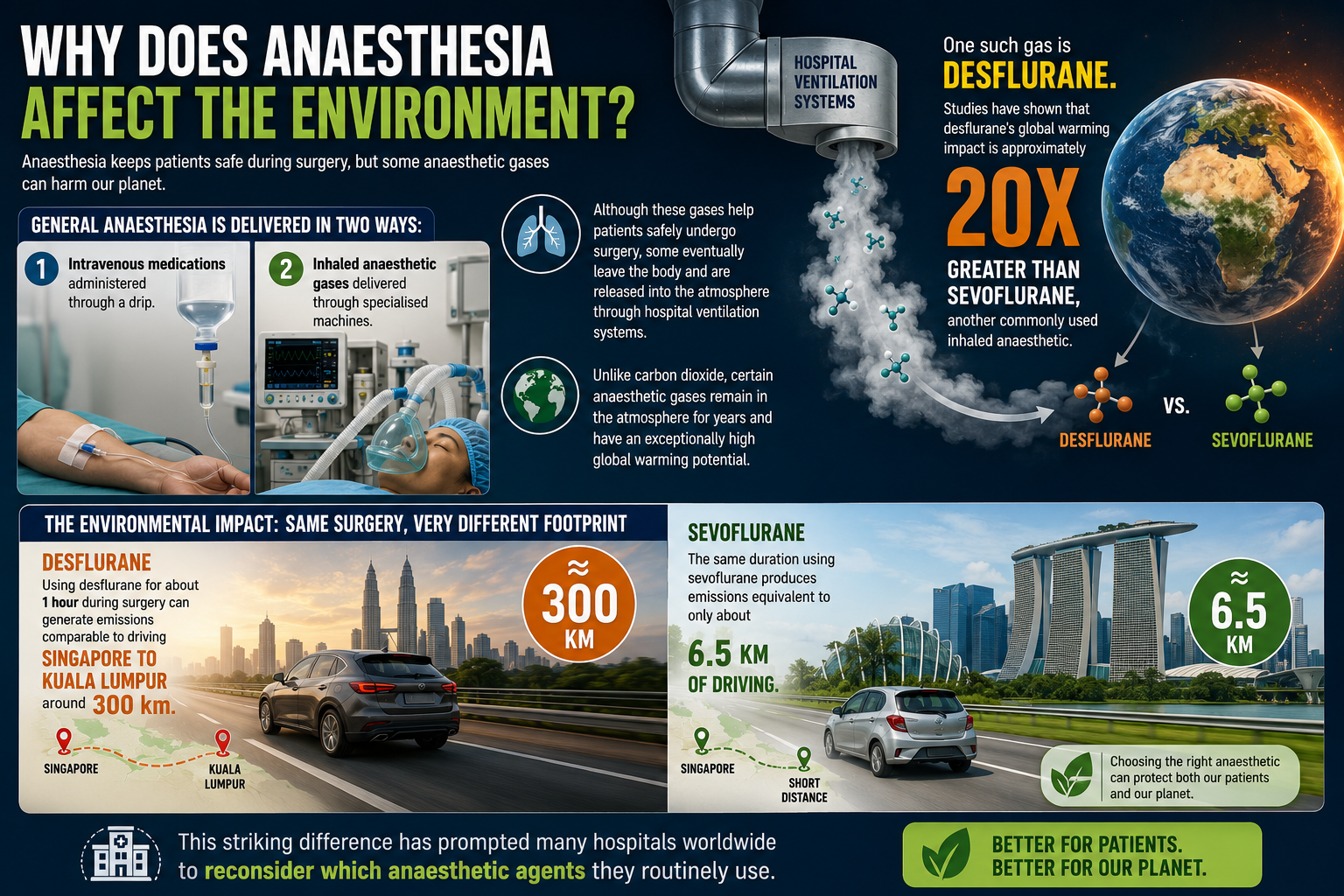
Some anaesthetic gases have a much greater environmental impact than others, making greener alternatives an important step towards sustainable healthcare.
General anaesthesia is usually delivered in one of two ways:
- Intravenous medications administered through a drip.
- Inhaled anaesthetic gases delivered through specialised machines.
Although these gases help patients safely undergo surgery, some eventually leave the body and are released into the atmosphere through hospital ventilation systems.
Unlike carbon dioxide, certain anaesthetic gases remain in the atmosphere for years and have an exceptionally high global warming potential.
One such gas is desflurane.
Studies have shown that desflurane’s global warming impact is approximately 20 times greater than sevoflurane, another commonly used inhaled anaesthetic. According to CGH, using desflurane for about one hour during surgery can generate emissions comparable to driving a car from Singapore to Kuala Lumpur—around 300 kilometres. The same duration using sevoflurane produces emissions equivalent to only about 6.5 kilometres of driving.
That striking difference has prompted many hospitals worldwide to reconsider which anaesthetic agents they routinely use.
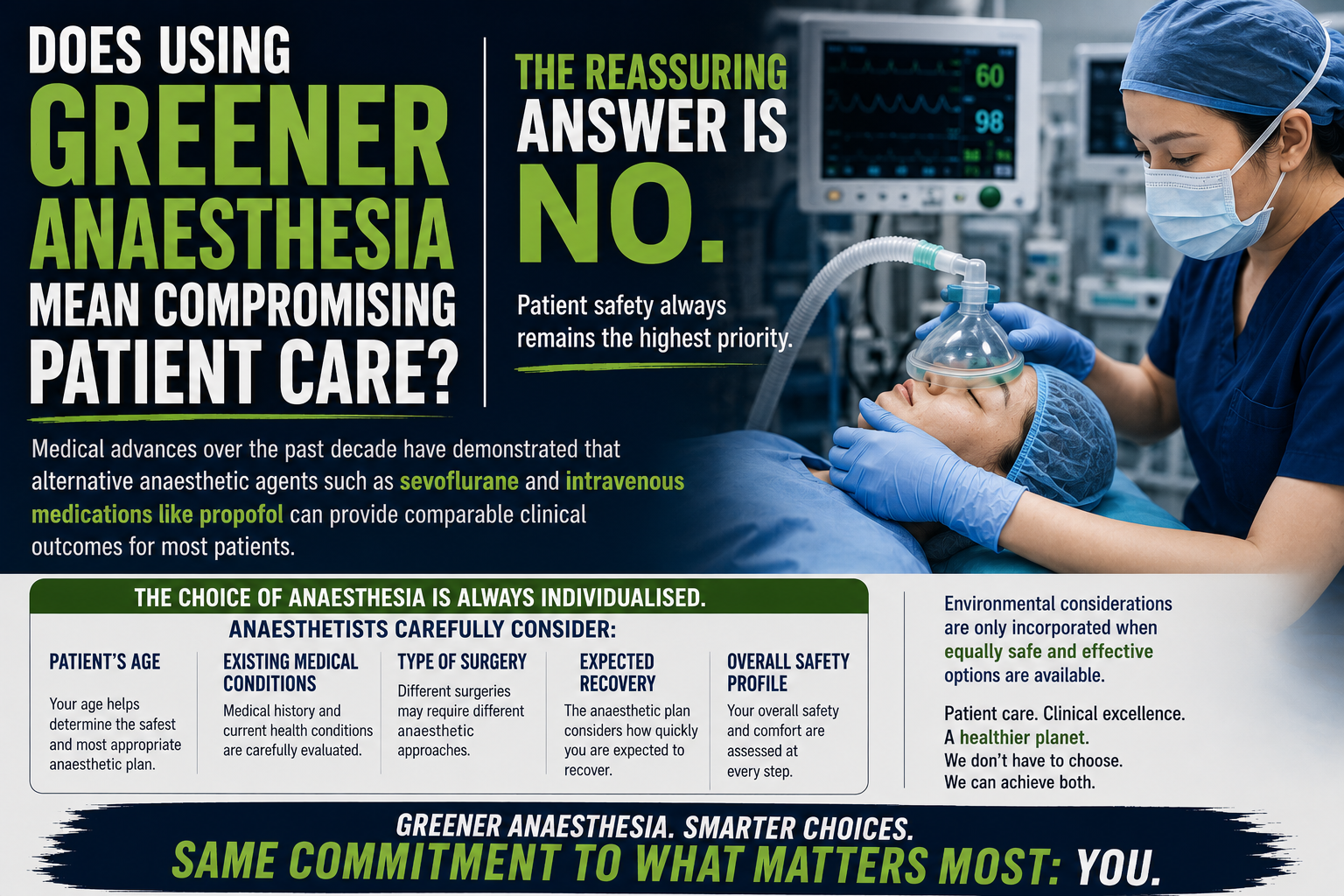
Greener anaesthesia can reduce environmental impact without compromising patient safety or clinical outcomes.
Does using greener anaesthesia mean compromising patient care?
The reassuring answer is no.
Medical advances over the past decade have demonstrated that alternative anaesthetic agents such as sevoflurane and intravenous medications like propofol can provide comparable clinical outcomes for most patients.
The choice of anaesthesia is always individualised. Anaesthetists carefully consider factors including:
- the patient’s age
- existing medical conditions
- the type of surgery
- expected recovery
- overall safety profile
Environmental considerations are only incorporated when equally safe and effective options are available.
Patient safety always remains the highest priority.
A quiet transformation happening behind the scenes
One reason many people are unaware of sustainable healthcare is that most changes happen behind the operating theatre doors.
At CGH, the transition away from desflurane began as early as 2019. Rather than making an overnight switch, the hospital gradually educated staff, modified clinical workflows and made desflurane available only when specifically required.
By 2025, desflurane use had fallen by more than 99%, and by 2026 the remaining equipment had been removed from the hospital entirely. Annual carbon emission reductions are estimated to exceed 900 tonnes of carbon dioxide equivalent compared with peak usage.
This demonstrates that meaningful environmental improvements often come from thousands of small clinical decisions rather than one dramatic technological breakthrough.
Sustainability extends far beyond the operating theatre

Proper waste segregation is a simple but important step towards more sustainable healthcare.
Anaesthetic gases are only one part of healthcare’s environmental footprint.
Many hospitals are now introducing initiatives such as:
- reducing single-use plastics
- improving recycling programmes
- installing energy-efficient lighting
- harvesting rainwater
- reducing food waste
- reusing textiles where appropriate
- digitising administrative processes

Hospitals are adopting greener practices, from recycling initiatives to reducing waste and conserving resources.
CGH, for example, has transformed retired hospital scrubs into reusable operating theatre caps, introduced food upcycling programmes and reduced packaging waste as part of its broader sustainability strategy.
These initiatives not only reduce environmental impact but can also lower operating costs and encourage more efficient use of resources.
Why greener healthcare matters to everyone
Climate change is increasingly recognised as a health issue.
Hotter temperatures, worsening air pollution and more frequent extreme weather events can all contribute to respiratory illnesses, cardiovascular disease, heat-related conditions and the spread of infectious diseases.
Healthcare therefore has a unique responsibility.
Hospitals exist to improve health—but they also consume significant energy and resources. Reducing unnecessary emissions where possible allows healthcare systems to care for today’s patients while helping protect the health of future generations.
As healthcare leaders around the world adopt more sustainable practices, patients are likely to see more environmentally conscious innovations that maintain the same high standards of safety and quality.
What patients should know
If you’re scheduled for surgery, there’s generally no need to request a specific anaesthetic.
Your anaesthetist will recommend the safest and most appropriate option based on your individual circumstances.
However, it’s reassuring to know that many hospitals are now considering both clinical excellence and environmental responsibility when planning patient care.
The operating theatre of the future is not only becoming smarter and safer—it is also becoming greener.
Key Takeaways
- Some anaesthetic gases have a much larger environmental impact than others.
- Greener alternatives can often provide equally safe and effective care.
- Changi General Hospital is Singapore’s first hospital to eliminate desflurane from routine surgical practice.
- Sustainable healthcare also includes reducing waste, conserving energy and improving resource efficiency.
- Patients can be confident that environmental initiatives are adopted only when they do not compromise safety or quality of care.









Leave A Comment