

Cancer Awareness & Oncology
Lymphoma: The Blood Cancer You Shouldn’t Ignore
by Dr Daryl Tan – Clinic for Lymphoma, Myeloma and Blood Disorders

A painless lump may be an early sign of lymphoma. Know the symptoms and seek medical advice if they persist.
Lymphoma is a cancer of the lymphatic system, part of the body’s infection-fighting network, which includes the lymph nodes, spleen, thymus and bone marrow. Because it can affect any of these organs, symptoms vary widely. Lymphoma includes more than 100 subtypes, mainly non-Hodgkin’s lymphoma (NHL) and Hodgkin lymphoma. Hodgkin lymphoma usually affects adolescents and young adults and is highly curable, even at advanced stages, with conventional chemotherapy. NHL is more common and includes many B-cell and T-cell subtypes. B-cell lymphomas make up about 85% of NHL, while T-cell lymphomas account for about 15%. NHL may be indolent or highly aggressive.
Targeted therapies and drug discovery have greatly improved B-cell lymphoma outcomes. Cure rates for aggressive disease have risen, and many indolent cases now behave more like chronic illnesses. These gains reflect better biology, global trial collaboration and faster drug approvals. Progress in T-cell lymphomas remains limited because they are rare and effective combination trials are few, leaving major unmet needs.
Prevalence in Singapore
In Singapore, lymphoma is the fifth most common cancer in men and sixth in women, with about 800 new cases yearly, according to the Singapore Cancer Registry Annual Report 2018.
Possible Causes and Risk Factors
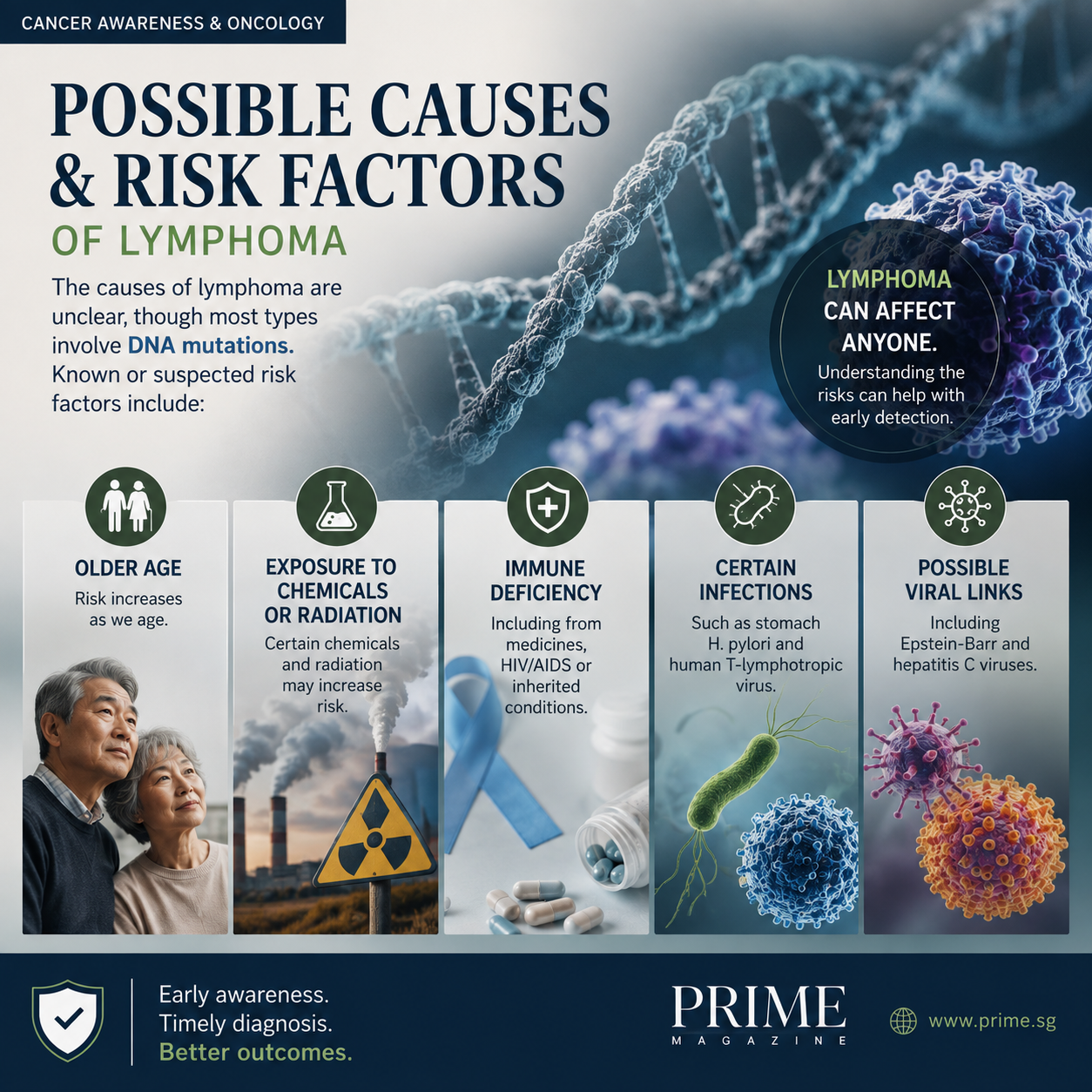
Understanding lymphoma risk factors can support greater awareness and earlier detection.
The causes of lymphoma are unclear, though most types involve DNA mutations. Known or suspected risk factors include:
- Older age
- Exposure to certain chemicals or radiation
- Immune deficiency, including from medicines, HIV/AIDS or inherited conditions
- Certain infections, such as stomach H. pylori and human T-lymphotropic virus
- Possible viral links, including Epstein-Barr and hepatitis C viruses
Common lymphoma symptoms include enlarged lymph nodes, lethargy, fever, night sweats, poor appetite, weight loss, pain, fatigue, itching and abnormal blood tests. Examination or CT/PET scans may reveal enlarged lymph nodes, liver or spleen. Diagnosis requires biopsy of abnormal tissue, often reviewed by an experienced haemato-pathologist, especially for rarer subtypes. Lymphoma may also involve bone marrow, where diagnosis can be made by bone marrow biopsy.
Modern Treatment Options for Lymphoma
Personalised Treatment Based on Lymphoma Type
Lymphoma treatment has advanced significantly and is tailored to subtype. Aggressive lymphomas need prompt treatment, while indolent types may be monitored until progression. Newer therapies focus on precision medicines and immune activation. As a result, the survival of patients with common lymphomas, such as diffuse large B-cell and follicular lymphoma, has improved markedly with rituximab as standard therapy. Genomic insights have also improved targeting of lymphoma-driving genomic abnormalities and cell-surface biomarkers. Although most Hodgkin lymphoma patients can now be cured, recent advances help identify those suited to less toxic treatment. However, T-cell lymphoma outcomes lag behind B-cell and Hodgkin lymphoma. Ongoing mutation studies may improve results over the next decade.
Conventional Chemotherapy and Stem Cell Transplantation
Conventional chemotherapy was long the main lymphoma treatment. Because lymphoma is a blood cancer, chemotherapy can reach cancer cells through the bloodstream, but it also damages healthy cells, causing side effects such as hair loss, nausea, diarrhoea, bleeding and infections. Autologous stem cell transplantation enables higher-dose chemotherapy without lasting bone marrow damage and remains standard for relapsed aggressive lymphomas.
Targeted Therapies and Immunotherapy
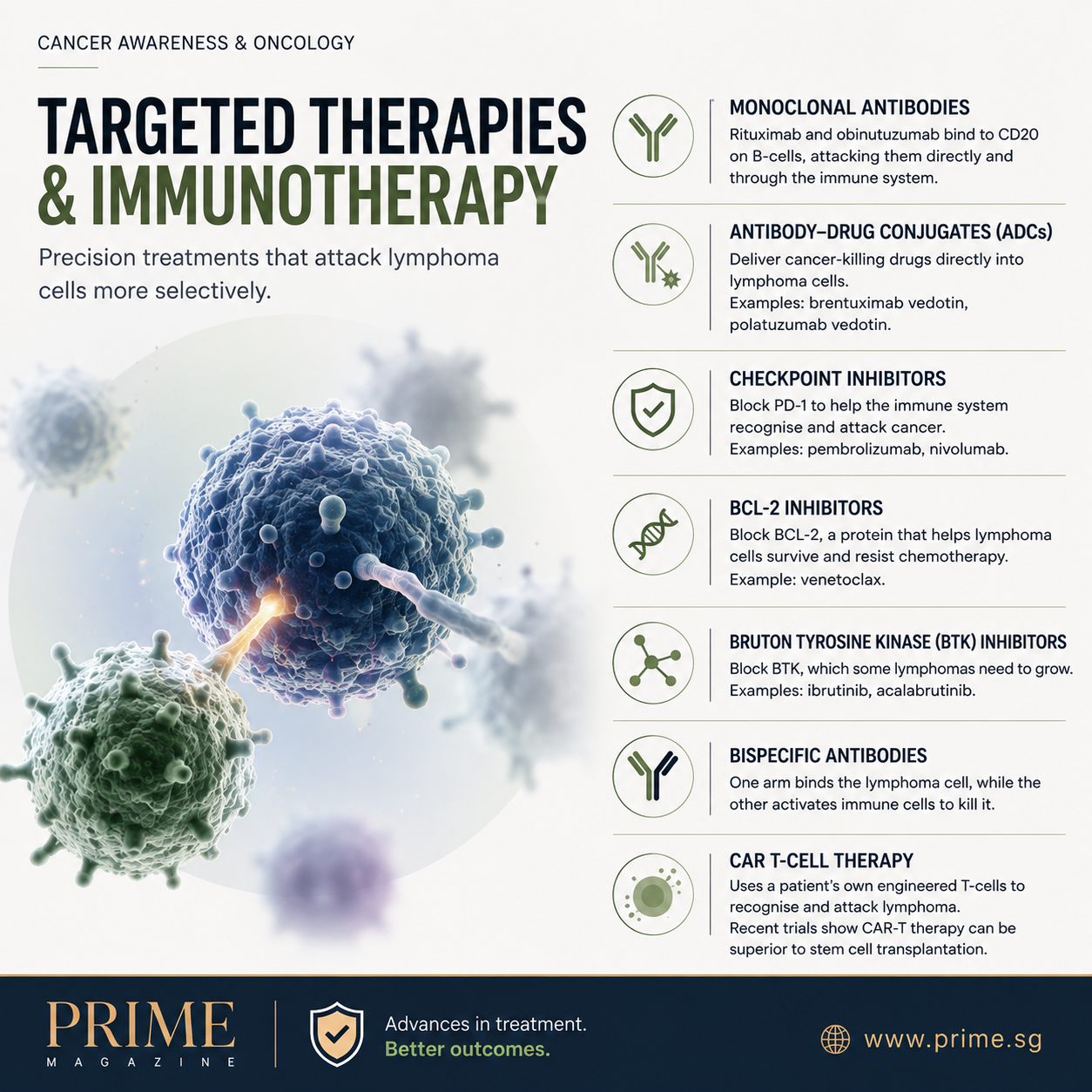
Targeted therapies and immunotherapy are transforming lymphoma treatment by attacking cancer cells more precisely.
Precision medicine now uses targeted drugs and immunotherapy to attack lymphoma cells more selectively. Key examples include:
- Monoclonal antibodies
Rituximab and the newer obinutuzumab attach to CD20 on B-cells and attack them directly and through the immune system. - Antibody-drug conjugates (ADCs)
ADCs use antibodies to deliver cancer-killing drugs directly into lymphoma cells. Examples include brentuximab vedotin and polatuzumab vedotin. - Checkpoint inhibitors
Checkpoint inhibitors help the immune system recognise and attack cancer by blocking PD-1. Pembrolizumab and nivolumab are now standard for relapsed Hodgkin lymphoma. - BCL-2 inhibitors
BCL-2 helps some lymphoma cells survive and resist chemotherapy. Venetoclax blocks BCL-2, helping cancer cells die. - Bruton tyrosine kinase (BTK) inhibitors
BTK inhibitors block BTK, which some lymphomas need to grow. Ibrutinib and acalabrutinib are now frontline options for selected lymphomas. - Bispecific antibodies
Bispecific antibodies help immune cells target lymphoma. One arm binds the lymphoma cell, while the other activates immune cells to kill it. - Chimeric Antigen Receptor (CAR) T-cell therapy
CAR T-cell therapy uses a patient’s own engineered T-cells to recognise and attack lymphoma. Recent trials comparing CAR-T therapy with autologous stem cell transplantation have shown superiority of CAR-T therapy over autologous stem cell transplantation.
Looking Ahead
With these and other emerging treatments, lymphoma outcomes should continue to improve, and precision medicine may eventually replace conventional chemotherapy.










Leave A Comment