
Orthopaedic Health Series
Knees That Keep Up: Managing Knee Osteoarthritis After 40, From Exercise and Injections to When Surgery Makes Sense
by Dr Tan Sok Chuen – Hip & Knee Orthopaedics
Knee pain after 40 is not just “old age.” Learn what common mistakes to avoid and how to stay active.
Knee osteoarthritis is common, but it does not have to mean a sedentary life. Understanding the options at each stage helps you choose the right treatment at the right time.
For many people in their forties and fifties, the first sign is subtle. The knees feel stiff after a long drive, climbing the stairs at the MRT station takes a little more effort, or the knees ache for two days after a weekend run. It is easy to put this down to getting older and simply do less.
Yet many treatments can help relieve knee osteoarthritis symptoms, and doing less is often the wrong response. In my clinic, patients often express surprise when they discover how much they can do to manage their symptoms long before they need to consider surgery.
WHAT IS HAPPENING INSIDE THE KNEE?
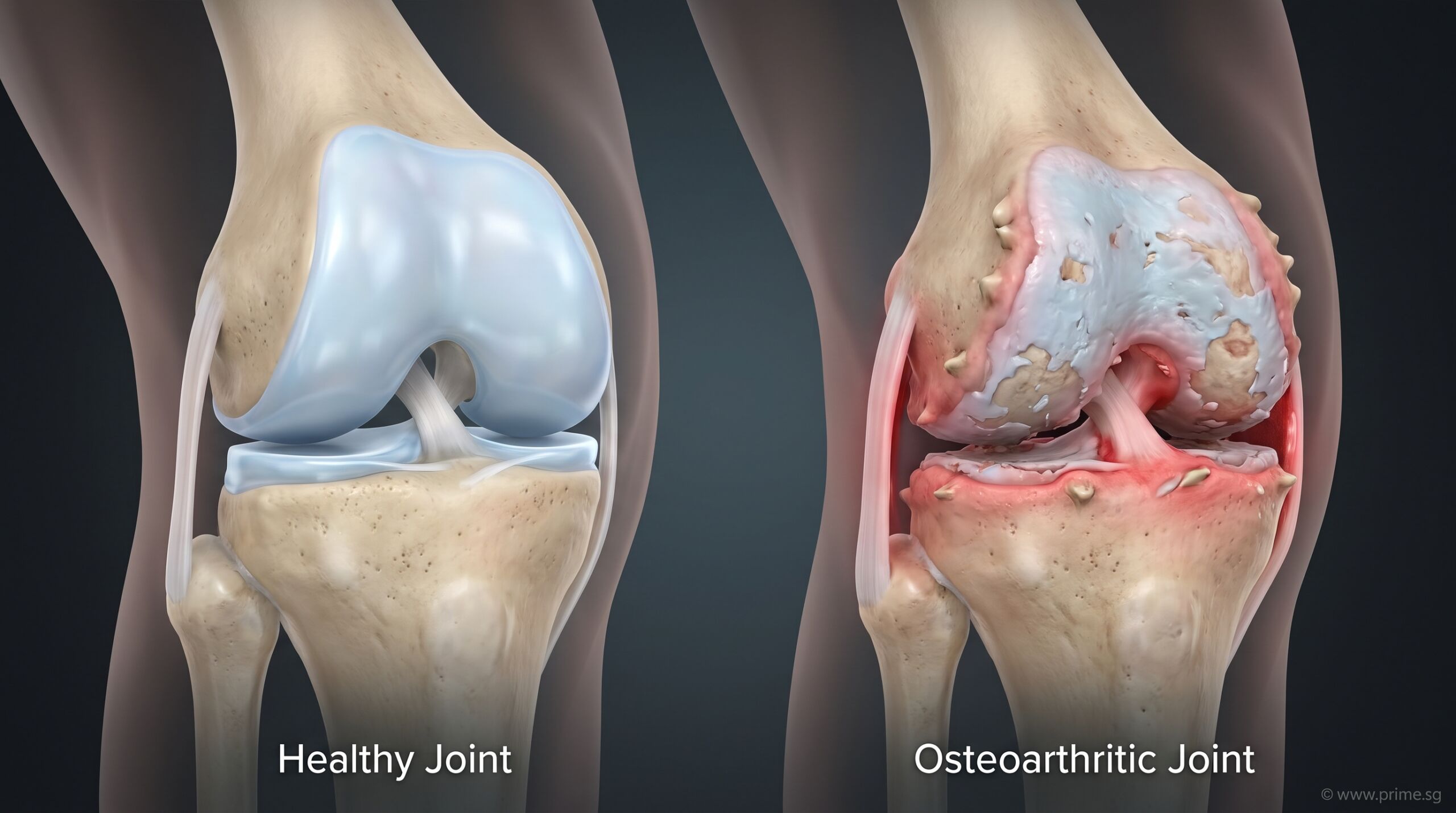
Healthy cartilage vs. osteoarthritis: see how joint wear and bone spurs trigger stiffness and pain.
A smooth layer of cartilage covers the ends of the bones in the knee, allowing the joint to glide. In osteoarthritis, this cartilage gradually thins and roughens. The bone underneath reacts, small bony spurs may form and inflammation can develop in the joint lining, causing pain, swelling and stiffness.
Osteoarthritis is extremely common. The Global Burden of Disease study estimated that around 595 million people worldwide were living with osteoarthritis in 2020, with the knee accounting for the most cases. Age, previous knee injuries, excess body weight, family history and the alignment of the legs all play a part.
Importantly, what an X-ray shows and how a knee feels do not always match. Some people with marked changes on X-ray have little pain, while others with mild changes struggle every day. Symptoms and daily function should therefore guide treatment, rather than the X-ray alone.
WHEN SHOULD YOU SEE A DOCTOR?
Occasional stiffness after unusual activity is rarely a cause for concern. However, you should see a doctor if you notice:
- Pain that has lasted more than a few weeks or keeps returning.
- Swelling of the knee, particularly after activity.
- Locking, catching or a sense that the knee may give way.
- Difficulty with stairs, squatting or getting up from a chair.
- Pain at night or at rest.
A doctor will review your symptoms and medical history, examine both knees and take weight-bearing X-rays as part of a thorough assessment. If the doctor suspects a meniscus tear, ligament injury or isolated cartilage defect, an MRI can help clarify the diagnosis. However, not every painful knee needs an MRI.
THE FOUNDATION: EXERCISE AND WEIGHT
International guidelines are consistent on this point. The Osteoarthritis Research Society International (OARSI), the American College of Rheumatology and the UK’s National Institute for Health and Care Excellence (NICE) all place structured exercise at the core of treatment for knee osteoarthritis.
Strengthening the muscles around the knee, especially the quadriceps and the hip muscles, reduces the load on the joint and improves stability. Low-impact activities such as cycling, swimming, brisk walking and water-based exercise maintain fitness without aggravating symptoms. A physiotherapist can design a programme that progresses safely.
For some people, weight management can also help ease knee symptoms. If you are above your healthy weight range, even a modest weight reduction may reduce pressure on the knees and improve comfort and mobility. The American College of Rheumatology guideline notes that losing 5 per cent or more of body weight is associated with improvements in pain and function, and the benefit tends to grow with greater weight loss.
Pain-relieving medication, such as paracetamol or anti-inflammatory gels and tablets, can help people stay active, but these work best as a support for exercise rather than a substitute for it.
WHERE INJECTIONS FIT IN
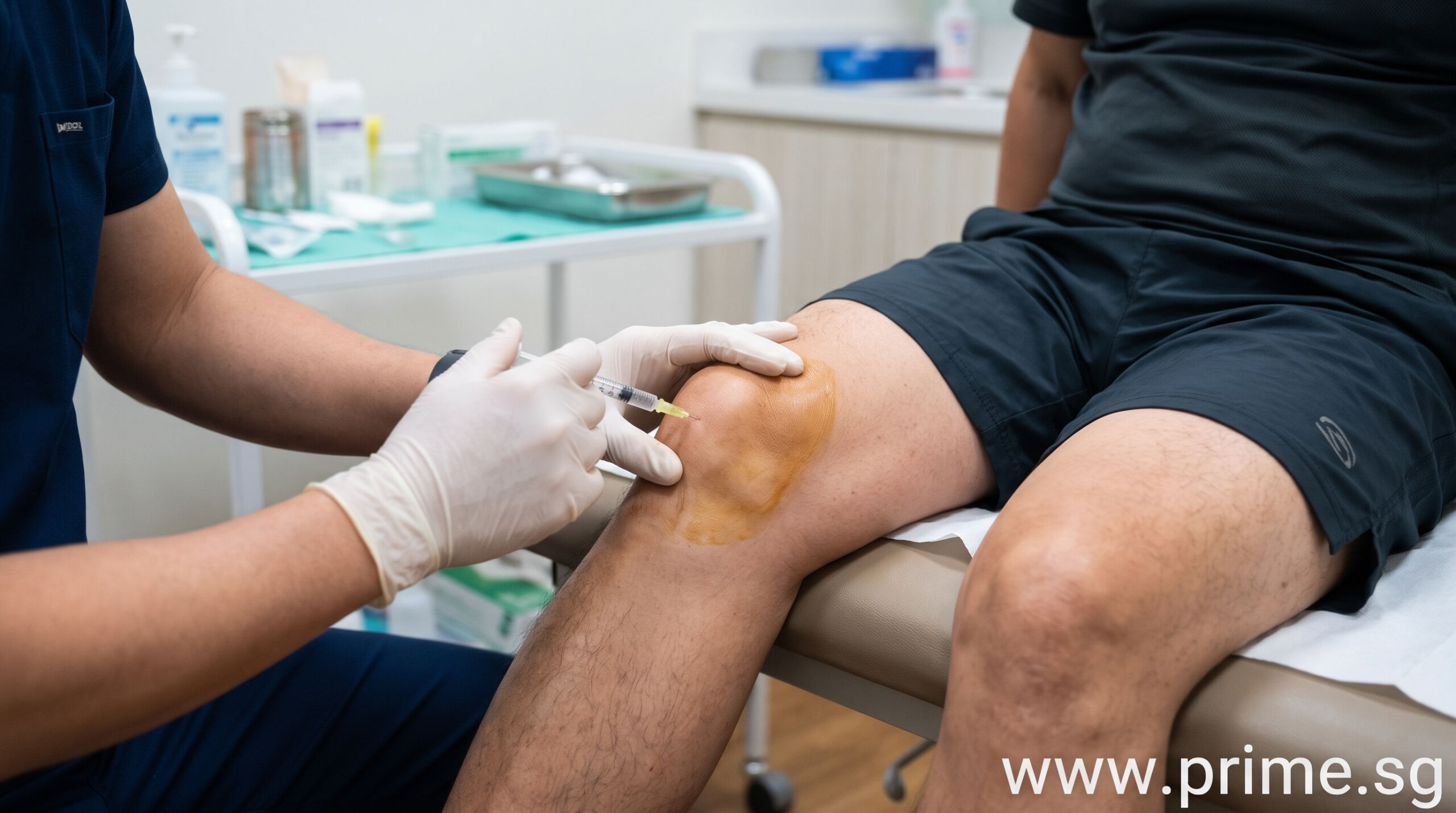
Targeted joint injections: providing fast anti-inflammatory relief to open a clear window for rehab.
When pain persists despite exercise and medication, an injection into the knee can provide relief and create a window in which rehabilitation becomes easier.
Corticosteroid injections reduce inflammation and often work within days. NICE recognises them as a short-term option when other treatments are not enough, although the effect tends to wear off over weeks to a few months, and repeated injections are generally used with caution.
Hyaluronic acid injections aim to supplement the natural lubricating fluid of the joint. The evidence for them is mixed: NICE does not recommend them, while some patients report useful relief and some guidelines in other countries consider them in selected cases. For this reason, they should be discussed honestly as one option among several, with realistic expectations.
Some clinics now offer a combined steroid and hyaluronic acid injection, which pairs the faster action of a steroid with the longer-acting lubricating component in a single treatment. As with any injection, it is best suited to mild to moderate osteoarthritis, and it should be part of a broader plan that includes strengthening exercise rather than a stand-alone fix.
Injections are not appropriate for everyone. Advanced osteoarthritis with severe bone-on-bone changes, significant deformity or mechanical symptoms caused by a loose fragment of cartilage may respond poorly, and other treatments may be more suitable.
WHEN SURGERY BECOMES THE RIGHT CONVERSATION
Surgery is considered when pain and loss of function significantly affect quality of life and non-surgical treatments have been given a fair trial.
For younger and active patients with a well-defined cartilage defect, often following an earlier injury, cartilage repair procedures may be an option. When osteoarthritis is confined to one part of the knee, a partial knee replacement may preserve the healthy compartments and ligaments. When the whole joint is affected, a total knee replacement remains a highly effective operation for relieving pain and restoring mobility.
The decision is a personal one. It depends not only on X-ray findings but also on how the knee limits your daily life, your general health and your goals, whether that means walking around the Botanic Gardens without pain or returning to tennis.
CAN KNEE OSTEOARTHRITIS BE PREVENTED?

Stronger legs protect joint cartilage. Low-impact outdoor workouts keep your knees moving pain-free.
Not every case can be prevented, but the risk can be reduced. Keeping to a healthy weight, staying active, building leg strength and treating knee injuries properly when they happen all help protect the joint over the long term.
The most important message is this: knee pain after 40 is common, but it is not something you simply have to accept. An early assessment allows treatment to begin when the simplest options are most effective.
References
GBD 2021 Osteoarthritis Collaborators. Global, regional, and national burden of osteoarthritis, 1990 to 2020 and projections to 2050. The Lancet Rheumatology, 2023.
Bannuru RR, et al. OARSI guidelines for the non-surgical management of knee, hip, and polyarticular osteoarthritis. Osteoarthritis and Cartilage, 2019.
Kolasinski SL, et al. 2019 American College of Rheumatology/Arthritis Foundation Guideline for the Management of Osteoarthritis of the Hand, Hip, and Knee. Arthritis Care & Research, 2020.
National Institute for Health and Care Excellence. Osteoarthritis in over 16s: diagnosis and management (NG226), 2022.










Leave A Comment