
Eye Health Series
Healthy Eyes at Every Age | Common Visual Conditions in Children and Young Adults (Part 1)
by Dr Khor Wei Boon – Singapore Eye & Vision
Many of us associate eye problems with old age, such as cataracts or glaucoma. However, a significant number of eye conditions can begin from childhood and these may have lifelong consequences. We take a look at the common eye conditions affecting children and young adults, and the steps that can be taken to prevent long-term harm to their vision.
Vision in a Child’s Growing Years
A child’s visual system is not fully formed at birth. It continues to develop throughout their early years. Childhood eye conditions are not always “visible”, and children often do not realise that their vision is abnormal or poor. This makes screening and early detection of eye problems especially important during this period.
Refractive Errors
Childhood myopia (short-sightedness) and astigmatism are the most common childhood eye problems I see in my clinic. When refractive errors are present, light rays that enter the eye are not focused properly onto the nerve layer of the eye, resulting in blurry vision. Glasses or contact lenses are needed to refocus these light rays to achieve good vision.
In Singapore, childhood myopia is increasingly prevalent, and children are developing it from an earlier age. Not only can poor vision limit their function in school and other activities, if left uncorrected, these refractive errors can interfere with their visual development, resulting in amblyopia (“lazy eye”) or strabismus. High myopia in childhood also increases the risk of serious eye diseases later in life, such as retinal detachments and glaucoma.
Children with myopia may:
- Hold books/digital devices close to their face.
- Have difficulty reading words in class.
- Squint their eyes to read text, whether far or up close.
- Tilt their face to one side when reading/watching TV.
Steps to prevent myopia:
- Encourage two hours of outdoor play daily. This reduces the risk of myopia.
- Children who have the warning signs above should have their prescription checked.
- Eye checks should be performed with an eye doctor. Eye drops are often required when checking the prescription of younger children (“cycloplegic refraction”).
Strabismus
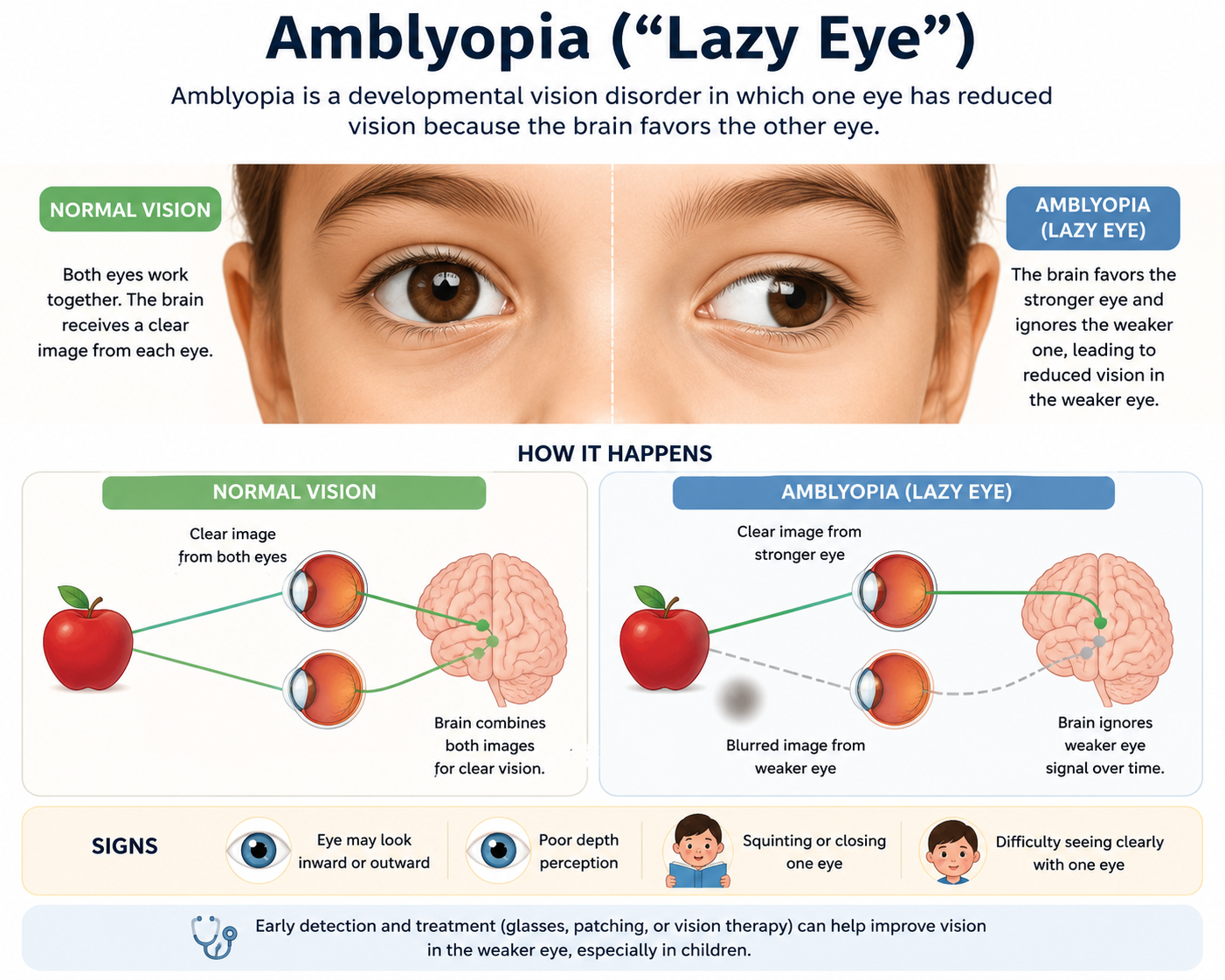
Strabismus refers to a situation where one eye wanders while the other eye is looking straight ahead (“cross-eyed”). The misaligned eye may turn inward or outward, or less commonly, upward or downward. This may affect just one eye, or shift between both eyes. This is not deliberate, and the child is often not even aware of it! While some cases are obvious, others may be mild and easily missed, or occur intermittently. Some children may unconsciously compensate for the misalignment by naturally turning/tilting their heads.
Strabismus can occur without an obvious cause. However, children can also develop strabismus due to underlying eye problems like uncorrected refractive errors (high myopia or hyperopia), and childhood cataracts or tumours in the eye, which are rare but serious. Other situations where strabismus may occur include premature births, neurological diseases or a family history of strabismus. Beyond the cosmetic appearance and its social impact, strabismus can also result in further vision problems, including:
- Amblyopia (“lazy eye”).
- Disruptions in the child’s stereoscopic vision – their ability to judge depth or visualise things in “3D”.
Children with suspected strabismus require a comprehensive eye examination to rule out refractive errors, and rare but important causes such as cataracts or brain-related disorders. In the absence of serious diseases, treatment of strabismus may include glasses, eye exercises or surgery.
Amblyopia (“Lazy Eye”)
Amblyopia occurs when one eye does not develop normal vision in childhood. Proper development of vision requires consistent visual input from both eyes to the brain. When one eye does not send as much input, the brain starts to suppress any input from that eye. This becomes permanent with time, and the affected eye may never see as clearly as the better eye.
While there can be many causes of amblyopia, the most common reasons are unequal refractive error between the two eyes, and strabismus. Again, these are conditions where one eye sends more input to the brain than the other eye, creating a situation where amblyopia can develop.
Treatment would first involve correcting any refractive errors and strabismus and then patching the stronger eye a few hours daily to force the brain to use the eye with amblyopia. Special eyedrops (“atropine”) can sometimes be used instead.
Unlike many adult eye conditions, amblyopia is largely irreversible if missed in childhood. When treatment is started before the ages of 7-8, there is a very good chance of reversing the amblyopia and restoring normal vision to the “lazy” eye. Results are much poorer when treatment is started after that age.
Steps to prevent amblyopia:
- Early vision screening and detection can make a big difference.
- Children with refractive errors, especially if the prescription is high or unequal, should wear their glasses at all times to prevent amblyopia.
- Kids with strabismus may need early surgical correction to prevent amblyopia.
Impact of Lifestyle/Work in Young Adults (20s–30s)
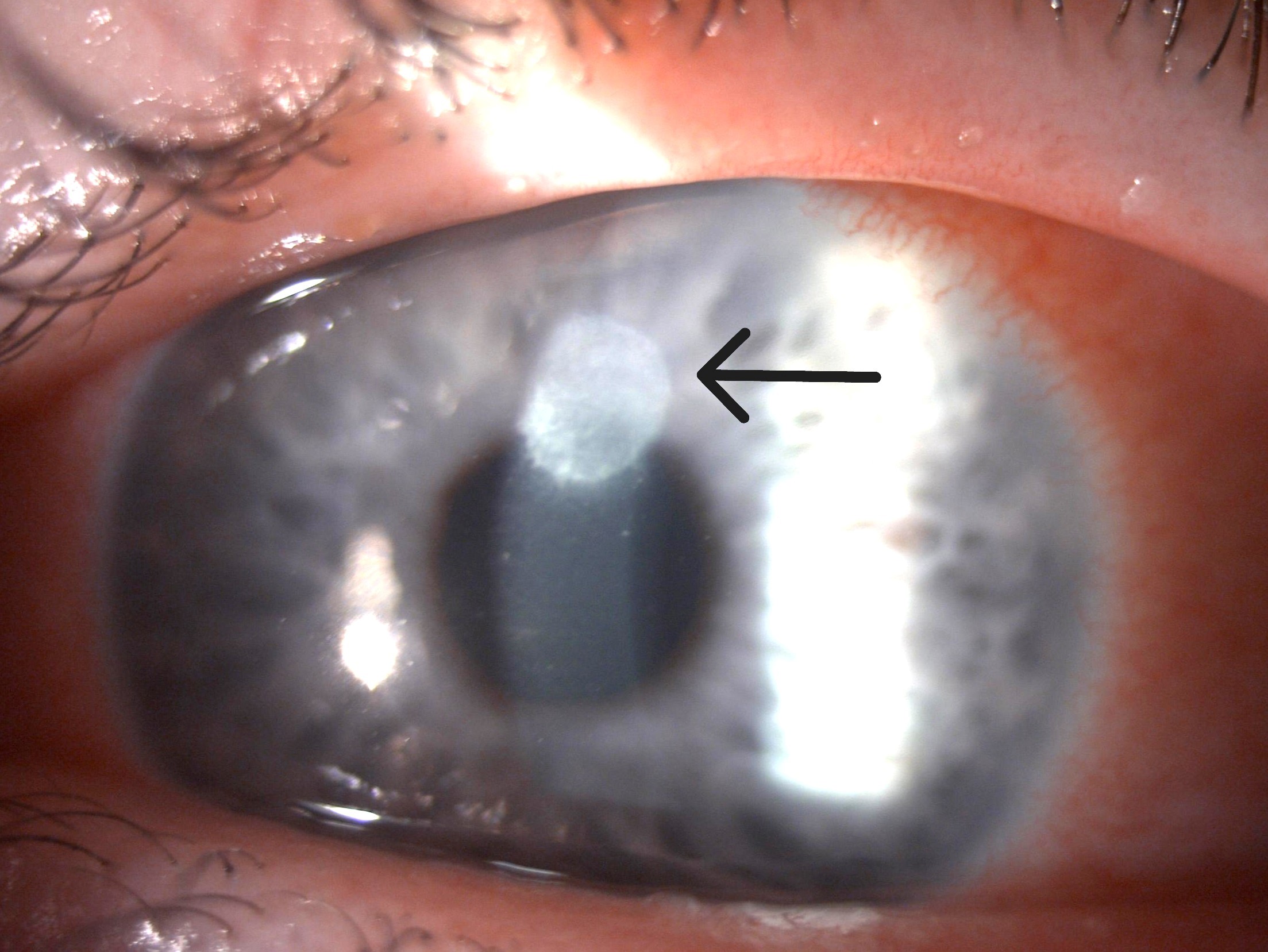
Close-up of an eye with a black arrow pointing to a round, cloudy scar on the cornea.
By the time individuals reach their 20s, the visual system is fully developed. Most adults in this age group have healthy eyes, but work and lifestyle factors can have a big impact on vision health.
Contact Lenses
Contact lenses are widely used by young adults to achieve good vision and enhance cosmetic appearances. But improper use can lead to problems such as redness, irritation and intermittent blurring of vision. It may even lead to complications like allergies, abrasions and corneal infections. Infections are especially serious as they can cause scarring of the cornea and a permanent loss in vision.
Poor contact lens habits include:
- Long hours spent wearing contacts daily.
- Overnight wear of contacts.
- Inconsistent cleaning, disinfection and storage of contacts.
- Swimming or showering with contacts.
- Buying contacts from unauthorised shops online or overseas. These lenses may be poor quality or counterfeit or stored/shipped improperly.
Steps to avoid contact lens problems:
- All contacts should always be fitted and prescribed by an optometrist.
- Follow your optometrist’s instructions on how to wear and care for your contacts.
- Get your eyes checked by your optometrist or ophthalmologist every six months.
- Do not ignore warning signs like redness, pain or blurring. Stop and get your eyes checked as soon as possible.
Eye Injuries
A close-up portrait with warm side lighting drawing attention to the eyes.
Young adults are more likely to engage in exercise and sports, as well as outdoors activities like cycling and trekking. While these are healthy and should be encouraged, they also carry a small risk of accidental eye injury, including:
- Scratches to the eye, such as corneal abrasions.
- Foreign bodies into the eye.
- Ultraviolet-injury to the cornea (exposure to intense sunlight).
- Blunt injury to the eyeball or eye socket.
While most injuries are minor and heal well, certain incidents may be more serious. These include high-impact injuries such as biking accidents, or from high-speed projectiles like tennis balls. Such injuries can result in fractures to the eye socket or damage to the structures in the eyeball, such as the lens and retina.
Steps to prevent eye injuries:
- Protective eyewear should be worn to prevent serious injury.
- Wear shatter-resistant polycarbonate lenses for activities with potential impact to the eyes.
- When skiing/trekking at high altitudes, wear UV-protective goggles to prevent ultraviolet-damage to the cornea (“photokeratitis”). PRIME


















Leave A Comment