
Cancer Awareness & Oncology
Movember 2026 and Prostate Cancer in Singapore

Raise awareness of prostate cancer this Movember 2026. Learn about prostate cancer, early detection and men’s health in Singapore.
by Dr Jay Lim – Urocare by Dr Jay Lim
Every November, moustaches make an appearance in the name of men’s health. Some are impressive. Others deserve marks for effort. But whether you grow one or remain clean shaven, Movember 2026 is a useful reminder to pay attention to a part of your body that usually receives very little attention: the prostate.
For many men, prostate health only becomes interesting when trips to the toilet become troublesome. Until then, there is work, family, and probably a car servicing appointment that somehow feels more urgent.
Let us change that. Prostate cancer awareness should help you understand your risk, recognise when to seek advice, and make sensible decisions about screening. You do not need a medical degree. Consider this your updated Prostate Cancer 101, with no examination at the end.
What is the prostate and why does it matter
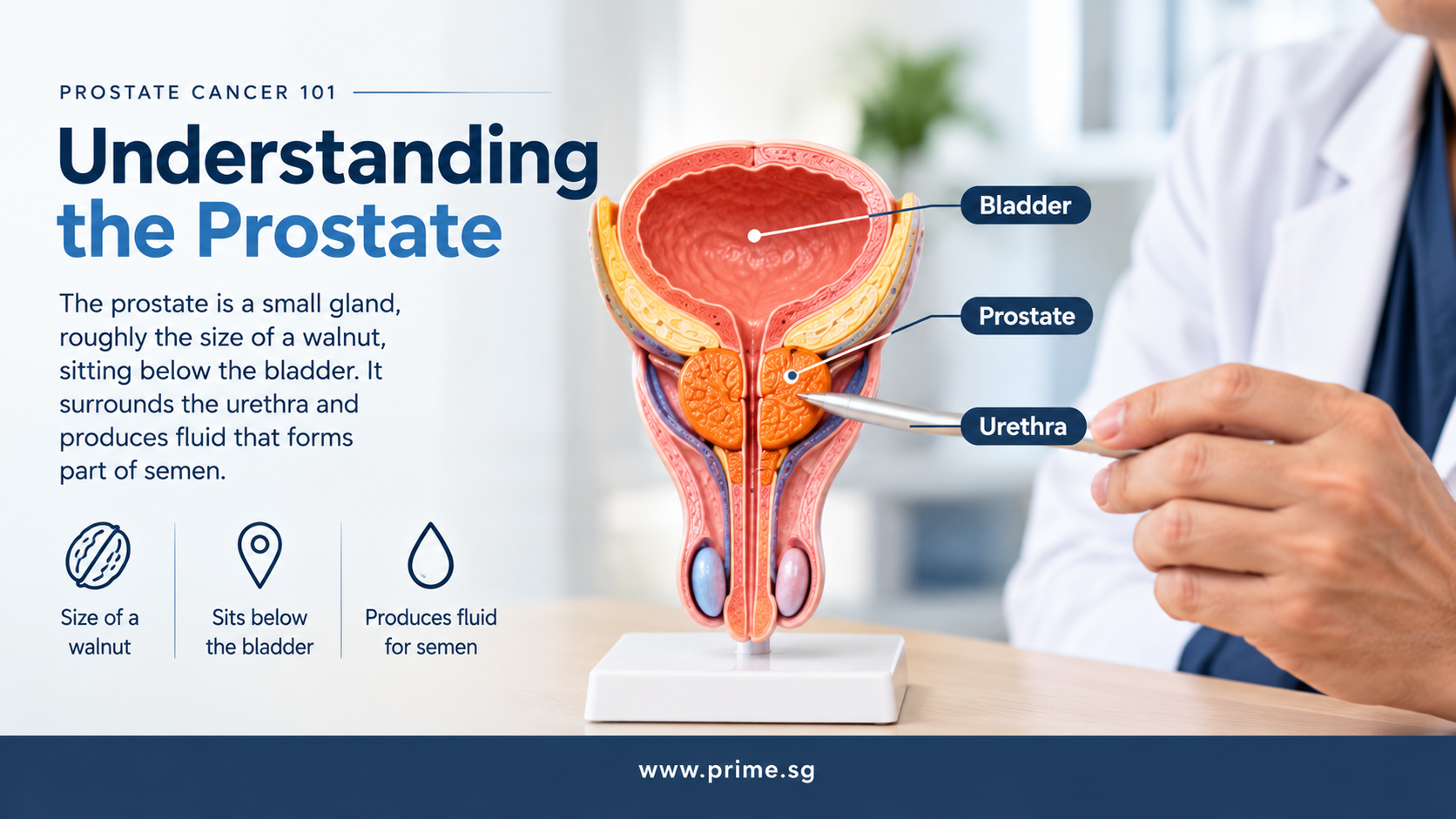
The prostate is a small gland located below the bladder that surrounds part of the urethra. Understanding its location and function can help men learn more about prostate health and prostate cancer.
The prostate is a small gland, roughly the size of a walnut, sitting below the bladder. It surrounds the urethra, the tube that carries urine out of the body, and produces fluid that forms part of semen.
Its position explains why an enlarged prostate can interfere with urination. Imagine a doughnut around a drinking straw. If the doughnut grows inward, the straw has less room. Unfortunately, your bladder cannot simply order a larger straw.
However, an enlarged prostate is not automatically cancer. Benign prostatic hyperplasia, or BPH, is noncancerous enlargement. Prostatitis means inflammation of the prostate, sometimes caused by infection. Prostate cancer is a different condition involving malignant cells. Similar symptoms can have different explanations, which is why guessing is rarely helpful.
Can prostate cancer develop without symptoms

Early prostate cancer may not cause noticeable symptoms. Learn about possible warning signs and when to seek medical advice.
Yes. Early prostate cancer often causes no noticeable symptoms. A comfortable trip to the toilet does not tell you everything about what is happening inside the prostate.
This matters because men sometimes wait for pain, bleeding, or urinary problems before considering their prostate health. Those symptoms deserve assessment, but their absence is not a reason to dismiss a discussion about screening.
Possible warning signs include difficulty passing urine, a weaker stream, blood in the urine, or persistent changes in urinary habits. These can also occur with benign conditions. Persistent unexplained bone pain may need investigation too.
Please seek urgent medical attention if you cannot pass urine, or if urinary symptoms occur with fever and feeling very unwell. Movember is an awareness month, not a waiting room until next November.
Who should discuss prostate cancer screening in Singapore
Screening means assessing someone who has no symptoms. Whether it is appropriate depends on your age, family history, health, and preferences.
For men at average risk, around age 50 is a reasonable time to discuss prostate cancer screening with a doctor. Men with a family history may need that conversation earlier, often around 45. Certain inherited mutations, particularly BRCA2, can justify discussion from around 40.
These ages start a conversation; they are not instructions for every man to arrange an annual blood test. Screening can identify important cancers earlier but can also lead to unnecessary investigations and treatment of cancers that would never cause harm.
Tell your doctor if your father or brother had prostate cancer, particularly at a young age. Relevant inherited cancer syndromes may also matter. Knowing the family story is more useful than relying on “I think someone had something”.
What does a PSA blood test actually tell you

A PSA blood test can help assess prostate health, but a raised result does not automatically mean cancer, and a normal result cannot rule it out completely.
PSA stands for prostate specific antigen, a protein produced by prostate cells. A PSA blood test measures its concentration, reported in nanograms per millilitre, or ng/mL. The test itself usually does not require fasting.
A raised PSA does not automatically mean prostate cancer. An enlarged prostate, inflammation, infection, and some recent activities or procedures can affect the result. Certain prostate medications can lower it.
Equally, a PSA below 4 ng/mL does not guarantee that cancer is absent. There is no single number that separates every healthy prostate from every cancerous one.
I would rather discuss what the result means for the person sitting in front of me than treat the laboratory’s red highlight as a diagnosis. Your age, previous readings, medications, examination, and prostate size may influence what happens next.
Sometimes the sensible next step is a repeat PSA after temporary causes have settled. Sometimes further investigation is appropriate. A blood test begins the assessment; it does not finish it.
Will I need a prostate examination or MRI
A digital rectal examination, or DRE, allows a doctor to feel part of the prostate through the rectum. Yes, this is the examination that tends to generate rather colourful accounts among friends afterwards.
It can provide useful information, but it is not a standalone test that rules cancer in or out. Your doctor will explain whether it is appropriate.
If further assessment is needed, a prostate MRI can help identify suspicious areas and guide decisions about biopsy. MRI findings are commonly described using PIRADS scores from one to five. Higher scores indicate greater suspicion, rather than a confirmed diagnosis.
Think of MRI as a map. A better map helps us decide where to look, but it cannot tell us everything about the tissue. A reassuring scan also needs to be considered alongside the rest of your assessment.
How is prostate cancer diagnosed
A prostate biopsy usually confirms the diagnosis by collecting small tissue samples for examination under a microscope. When MRI identifies a suspicious area, targeted sampling can be used, sometimes alongside additional samples.
One approach is transperineal biopsy, where the needle enters through the skin between the scrotum and anus. Compared with passing through the rectum, this route generally reduces infectious complications. It still carries risks, including bleeding, discomfort, infection, and temporary difficulty passing urine.
The biopsy technique and anaesthetic depend on your situation and the available service. The important question is how the proposed procedure helps answer your particular clinical question.
The pathology report describes whether cancer is present and, if so, its grade. Further assessment establishes its extent. Grade and stage are different pieces of the puzzle: how the cancer behaves and where it is.
Does every prostate cancer need immediate treatment
No. Some prostate cancers grow slowly; others behave more aggressively. The challenge is identifying which situation applies to you.
Active surveillance may suit selected men with low-risk disease. This involves planned monitoring, with treatment considered if findings change. Watchful waiting generally focuses on managing symptoms if they develop, often when age or other illnesses make curative treatment less appropriate.
For cancers requiring treatment, options may include surgery, radiotherapy, and medicines, depending on the disease. Robotic surgery is one surgical approach, but the presence of a robot does not make an operation the right choice for everyone.
Treatment discussions must include possible effects on urinary control, sexual function, and quality of life. In my approach, the decision is a shared one. Does treatment offer meaningful benefit? What are its risks? How does it fit your priorities?
Can I prevent prostate cancer with diet or supplements

Can diet or supplements prevent prostate cancer? Healthy lifestyle habits support overall health, but no diet or supplement is proven to guarantee prevention.
There is no proven diet or supplement that guarantees prevention of prostate cancer. Healthy habits are worthwhile, but they should not be marketed as an invisible shield around the prostate.
Keep physically active, maintain a healthy weight, avoid smoking, and eat a balanced diet for your overall health. Be cautious about products promising to prevent cancer or replace proper medical assessment.
Screening and prevention are also different ideas. A PSA test does not stop cancer from developing. Its purpose is to help assess risk and identify who may need further investigation.
If you are already taking supplements or medication, bring the list to your appointment. That is more helpful than trying to remember the colour of the bottle.
Make your Movember conversation count
You do not need to arrive at the clinic knowing all the answers. Bring previous PSA results, your medication list, and any relevant family history. Write down changes you have noticed and the questions you are reluctant to ask. Urination, erections, ejaculation, and cancer worries are all reasonable subjects for a urology consultation.
A useful appointment should leave you knowing why a test is being suggested, what its possible results mean, and when to return. Ask who will explain the findings and what happens if you choose monitoring. If something remains unclear, ask again. There are no bonus marks for nodding politely while worrying all the way home. Understanding your plan is part of taking care of yourself properly.
Family members are welcome to help start the conversation, but men can take ownership of it too. Asking for advice is a practical decision about your health.
This Movember 2026, give your prostate a little more attention than your moustache. If you have symptoms, a raised PSA, or questions about your risk, arrange a discussion with your doctor or a urologist in Singapore.
At The Urocare Clinic by Dr Jay Lim, we can discuss your prostate health and whether further assessment is appropriate. The aim is a clear plan that you understand, with decisions made together. PRIME








Leave A Comment