

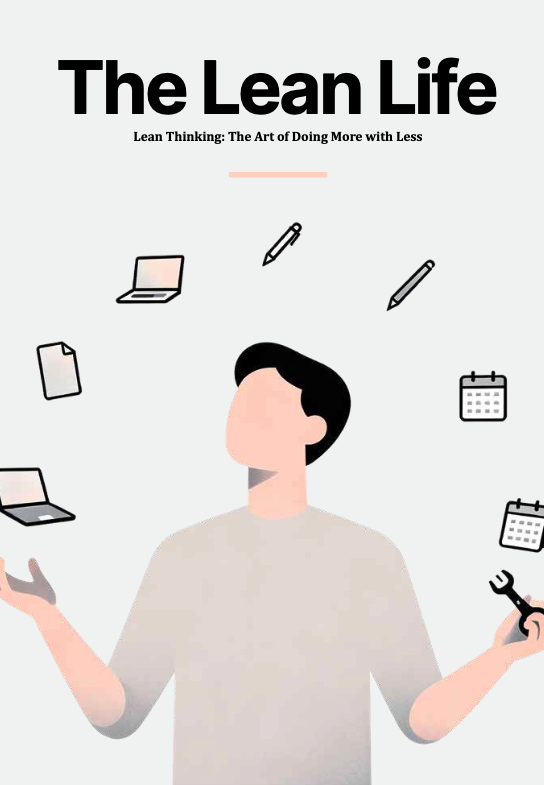
At work and in our daily lives, we often find our to-do lists never ending and our inboxes refilling faster than we can empty them. Efficiency has become the holy grail of modern life. We crave more time, fewer mistakes, simpler routines, and smoother days — yet often end up working harder and longer instead.
But what if the secret to doing more is not about working harder or longer, but thinking leaner?
Importantly, Lean Thinking is not a corporate buzzword or the latest productivity fad. It is a century-old philosophy and mindset that has quietly transformed industries, startups, and even households. Born on the factory floors of early-20th-century America and post-war Japan, Lean Thinking has since found its way into hospitals, schools, kitchens, and daily routines.
Its beauty lies in its elegant simplicity: focus on value, eliminate waste, and strive for continuous improvement.
From Car Factories to the World
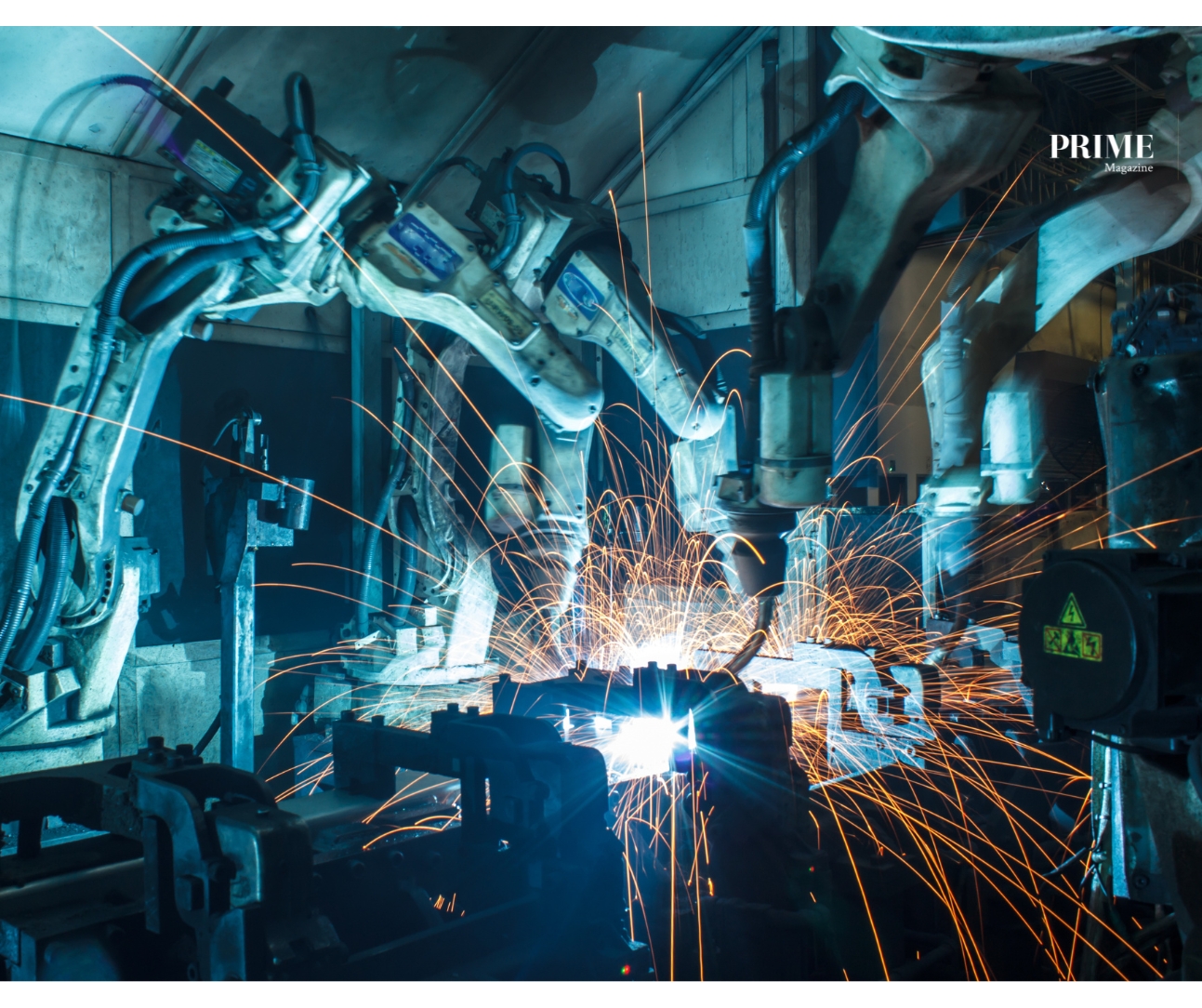
Car factory.
While many trace the roots of Lean Thinking to post-World War II Japan, its origins can be traced even further back to the early days of American car manufacturing.
In the early 1900s, Henry Ford revolutionised automobile production by introducing the first moving assembly lines. He limited production to a single standard chassis, making it easier to standardise parts and processes. Each worker on the assembly line was responsible for a specialised task, performed repeatedly. This reduced training time, tool changes, and inefficiencies.
However, while Ford’s approach worked well for mass production, it struggled in environments that required flexibility or multiple product variations.
The Toyota Production System and the Birth of Lean
In contrast, post-war Japan faced a very different reality. Resources were scarce, factories were damaged, and capital was limited. At Toyota, industrial engineer Taiichi Ohno faced a pressing challenge: how to produce cars efficiently without the scale and abundance enjoyed by American manufacturers.
Rather than copying Ford’s mass-production model, Ohno re-imagined the entire system. Together with his colleagues, he developed what would later become known as the Toyota Production System (TPS) — a framework built around efficiency, respect for people, and continuous improvement.
Ohno observed that most production processes were riddled with waste: time spent waiting, excess inventory, unnecessary movement, overproduction, defects, and redundant effort. He called these wastes muda. By eliminating muda, Toyota could build cars faster, cheaper, and with higher quality.
More importantly, TPS was not just about tools or techniques. It was a philosophy — a way of seeing work through the lens of value. Every action had to serve a purpose. If it did not, it was eliminated.
How Lean Thinking Became a Global Movement
In 1988, researcher John Krafcik coined the term Lean Thinking while analysing Toyota’s production efficiency at MIT. Later, scholars such as James P. Womack, Daniel Roos, and Daniel T. Jones studied TPS extensively and helped bring its principles to the West.
Their 1996 book Lean Thinking distilled Toyota’s methods into five universal principles. The book became a global bestseller, and Lean Thinking spread beyond factories into healthcare, education, software development, and government.
Toyota was not just efficient — it was agile, resilient, and disciplined. That insight changed how organisations around the world approached work.
Core Principles of Lean Thinking

Success built step by step on strong values.
At its heart, Lean Thinking rests on five enduring principles.
Define Value
Everything begins with the customer. Value is defined by what the end user truly needs or is willing to pay for. Anything else — no matter how clever or time-consuming — is waste.
Map the Value Stream
Once value is defined, every step involved in delivering it is mapped out. This reveals non-value-adding activities and inefficiencies, whether in a business process or a daily routine.
Create Flow
Work should move smoothly without interruption, delay, or bottlenecks. Removing friction allows tasks to progress naturally and efficiently.
Establish Pull
Instead of producing in anticipation of demand, Lean systems respond only to real needs. Nothing is done until it is required by the next step or the customer.
Seek Perfection
Lean Thinking is never finished. Continuous improvement — or kaizen — encourages constant refinement, curiosity, and learning.
How Lean Thinking Works in Practice
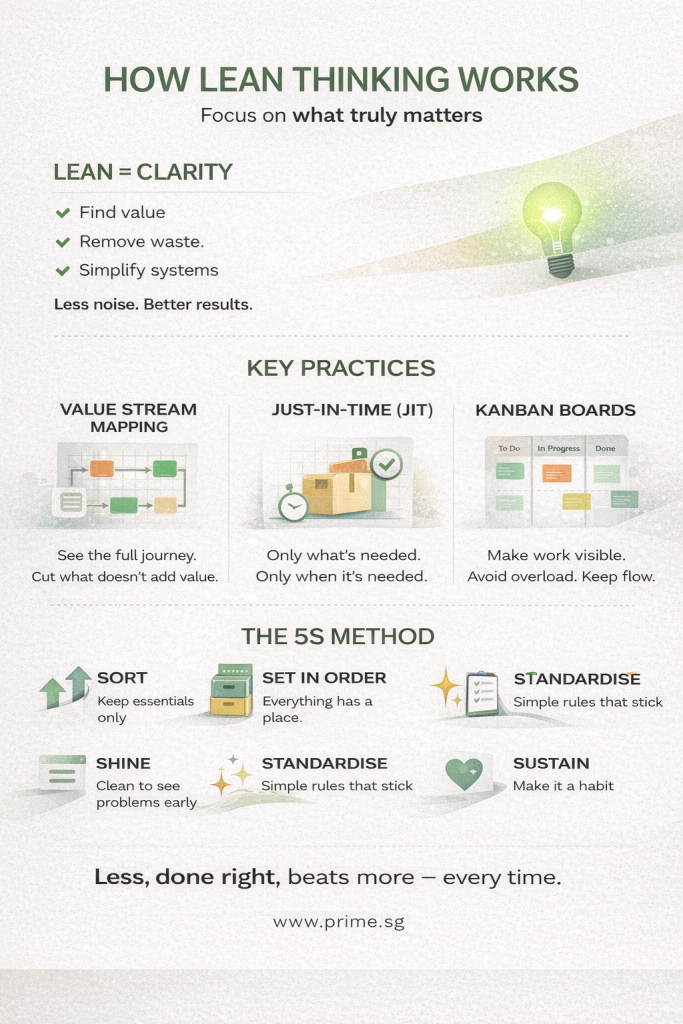
HOW LEAN THINKING WORKS IN PRACTICE
At its core, Lean Thinking is fundamentally a process of discovery. It asks simple but powerful questions: What adds value? Where is waste hiding? How can this be simpler?
Common Lean practices include:
Value Stream Mapping
Visualising the entire process from start to finish helps teams identify waste and shorten the path to the customer.
Just-In-Time (JIT) Production
Materials are delivered only when needed, reducing clutter and excess inventory. In daily life, this might mean cooking only what you will eat.
Kanban Boards
Tasks are visualised as they move from To Do to In Progress to Done, keeping work visible and preventing overload.
The 5S Method
A system for workplace organisation that promotes clarity and efficiency:
-
Sort
-
Set in order
-
Shine
-
Standardise
-
Sustain
Root Cause Analysis
Problems are solved at their source using techniques such as the “Five Whys,” rather than applying temporary fixes.
Kaizen
Small, incremental improvements made consistently over time lead to significant results.
Lean Thinking Beyond the Factory

Creative idea emerging from the mind.
Lean Thinking extends far beyond manufacturing. Hospitals use it to reduce patient waiting times and errors. Software teams apply Lean Startup principles to test ideas quickly. Educators use it to streamline workflows and focus on outcomes.
More importantly, Lean Thinking is not just for organisations — it is for individuals seeking clarity and calm in daily life.
Lean Thinking in Daily Life
Everyday routines can be examined through a Lean lens. Morning chaos, for example, often stems from poor flow: misplaced keys, cluttered wardrobes, or inefficient habits.
By removing friction — organising essentials, decluttering, preparing ahead — mornings become calmer and more intentional.
Lean principles also apply to finances, digital habits, and even relationships. Clear communication reduces emotional waste. Small, regular check-ins act as emotional kaizen, strengthening connection over time.
Lean Thinking at Work

Illustration of a person working on a laptop with a stylus.
Lean Thinking only succeeds when it is rooted in respect for people. At Toyota, every worker was encouraged to suggest improvements. Mistakes were treated as learning opportunities, not failures.
In a Lean workplace, meetings are purposeful, emails are concise, and work is prioritised by value. Managers act as coaches, and teams feel ownership of their processes.
When done well, Lean Thinking improves not just productivity, but morale and trust.
LEAN THINKING FOR YOURSELF

Frustrated woman at work.
Though it may sound mechanical, Lean Thinking is deeply human. It respects people’s desire to do meaningful work without frustration. It encourages empathy, listening, and humility.
The principle of continuous improvement reminds us that perfection is unattainable — but progress is always possible. This mindset builds resilience, patience, and curiosity.
A Modern Philosophy for a Cluttered World

A modern philosophy illustration
We live in an age of excess: too much information, too many choices, and too little time. Recent years have forced many to rethink how they work and live. The lesson is clear — productivity is not about doing more things, but about doing the right things.
Lean Thinking requires no special training. Only honesty and curiosity.
Ask yourself:
-
What truly adds value to my life?
-
What drains energy without benefit?
-
What small improvement can I make today?
Each change compounds over time. In a cluttered world, Lean Thinking is the gentle art of focus — a reminder that less, done right, is infinitely more. PRIME








Leave A Comment