

If you’ve heard of Swedish death cleaning, chances are you’ve also thought of Marie Kondo.
Both approaches encourage decluttering. Both promise a calmer home and a clearer mind. And both have helped millions rethink their relationship with possessions.
Yet while they may look similar on the surface, Swedish death cleaning and the Marie Kondo method are guided by very different philosophies — shaped by different life stages, emotional priorities, and ideas of what it means to live well.
Understanding the difference can help you decide which approach suits you best — or whether a mix of both might be the answer.
The Marie Kondo Method: Choosing Joy in the Present
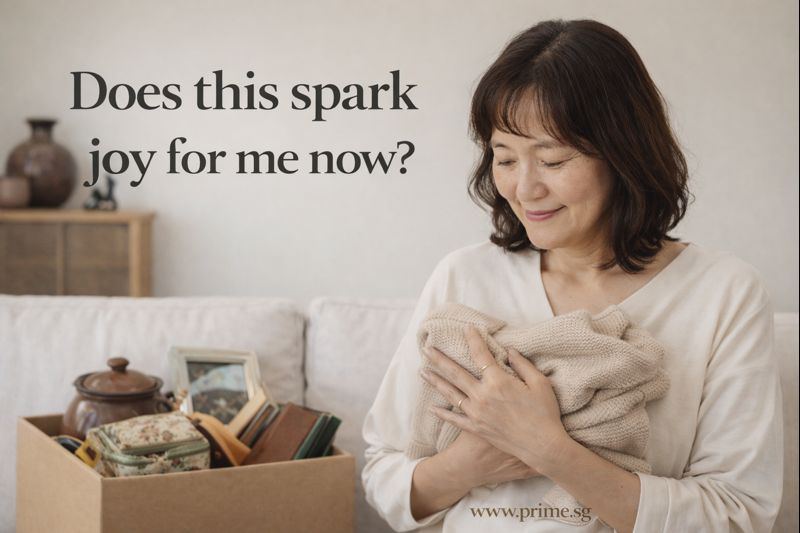
Joyful decluttering in a light-filled home, inspired by the Marie Kondo method of choosing what sparks joy.
Popularised by Marie Kondo, the KonMari method asks a simple but powerful question: Does this spark joy?
If the answer is yes, you keep the item.
If not, you thank it — and let it go.
At its core, Marie Kondo’s approach is about:
-
Focusing on personal happiness
-
Becoming more aware of what brings joy
-
Creating a home that feels uplifting and energising
It often resonates with people earlier in life — young adults, families with children, or anyone looking to reset their space and mindset. The emotional centre of the method is joy: what makes you feel good right now.
Swedish Death Cleaning: Choosing Peace for the Future

Young Woman Sorting Wardrobe Indoors at Home.
Swedish death cleaning, on the other hand, approaches decluttering from a quieter, more reflective angle.
Rather than asking what sparks joy today, it gently asks:
If someone else had to sort through this one day, would I want them to?
This practice encourages people — often in midlife or later — to reduce excess belongings while they are still well and clear-minded. The focus is not on happiness in the moment, but on peace of mind, clarity, and consideration for loved ones.
Where Marie Kondo’s method is individual-centred, Swedish death cleaning is family-centred. It acknowledges that our belongings do not exist in isolation — one day, someone else may have to deal with them.
The Key Difference Is Not the Objects — It’s the Intention

Cluttered shelf vs clean shelf
Both approaches involve sorting, keeping, and letting go. The real difference lies in why.
Marie Kondo asks:
-
What do I love?
-
What brings me joy?
Swedish death cleaning asks:
-
What truly matters?
-
What will be a burden to others?
One is rooted in personal fulfilment.
The other is rooted in care and responsibility.
Neither is better — they simply serve different emotional needs.
Different Life Stages, Different Priorities
For many people, the Marie Kondo method feels liberating during busy, accumulation-heavy years. It helps cut through clutter and reconnect with personal values.
Swedish death cleaning tends to resonate later, when perspectives shift. Priorities often move from acquiring to simplifying, from self-expression to legacy, and from “What do I want?” to “What do I want to leave behind?”
In Singapore, this distinction can feel especially relevant. With compact living spaces and close family ties, decluttering often affects not just one person, but the entire household — including adult children who may eventually take on the responsibility of managing a parent’s belongings.
Do You Have to Choose One?
Not at all.
Many people find that the two approaches complement each other beautifully. You might start by using Marie Kondo’s method to reconnect with what brings joy, then later adopt the mindset of Swedish death cleaning to refine what remains.
You can ask both questions:
-
Does this matter to me?
-
Will this matter — or burden — someone else?
Together, they offer a more holistic way of relating to the things we own.
A Thoughtful Way to Let Go
Asian parents and adult children at home
At their best, both Marie Kondo’s method and Swedish death cleaning remind us that decluttering is never really about objects. It is about awareness, intention, and how we choose to live.
Whether you are seeking joy, peace, or a little of both, the act of letting go can be deeply life-affirming — not because you end up with less, but because you become clearer about what truly deserves space in your life. PRIME








Leave A Comment