

Peacocks are among the most visually striking birds in the world, famous for their shimmering blues, greens, and golds. But their dazzling appearance is not just for show. The vibrant colours of peacocks play a vital role in survival, reproduction, and evolution — and the science behind them is more fascinating than it may seem.
First, a quick clarification: the term peacock refers specifically to the male of the species. Females are called peahens, and together they are known as peafowl. Only male peafowl display the spectacular, colourful tail feathers that people commonly associate with peacocks.
Colour as a Tool for Attraction
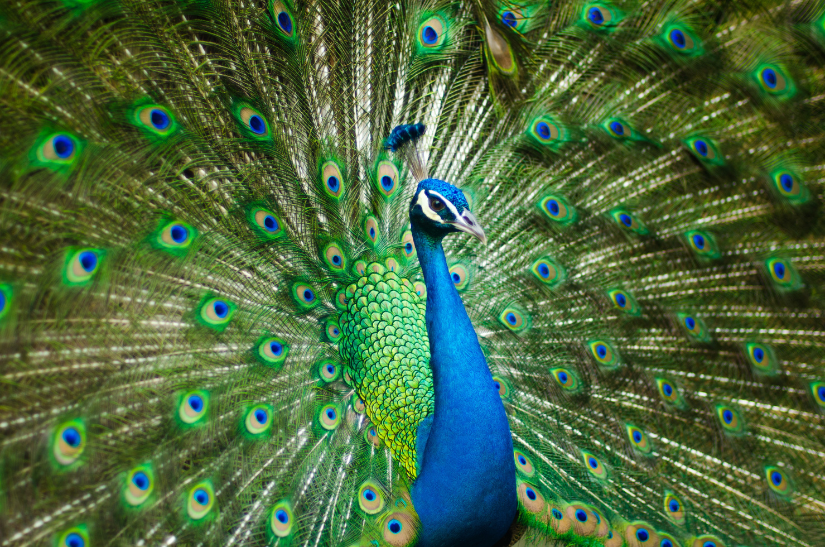
The primary reason peacocks are so colourful lies in sexual selection. During mating season, male peacocks fan out their long tail feathers — known as a train — into an impressive display to attract peahens. This display can include over 200 elongated feathers, each decorated with eye-shaped patterns called ocelli.
Peahens carefully observe these displays and tend to prefer males with larger, brighter, and more symmetrical trains. Over generations, this preference has driven peacocks to evolve increasingly elaborate feather displays. In evolutionary terms, colour becomes a signal — advertising a male’s genetic quality to potential mates.
Not Pigment, But Physics
Interestingly, the brilliant colours of peacock feathers are not mainly produced by pigments, as is the case with many animals. Instead, they result from structural colouration.
Peacock feathers contain microscopic structures made of keratin — the same protein found in human hair and nails. Within the feather barbules are carefully arranged layers of tiny rod-like structures. These act like natural photonic crystals, interacting with light in complex ways.
When light hits these structures, certain wavelengths are reflected while others cancel out. This selective reflection creates the intense blues, greens, and shimmering iridescence that change depending on viewing angle. That is why a peacock’s feathers seem to “shift” in colour as the bird moves.
A Signal of Health and Fitness
From an evolutionary perspective, producing and maintaining such extravagant feathers is costly. Growing large, colourful trains requires energy, good nutrition, and a strong immune system. The feathers must also remain intact despite exposure to predators, parasites, and environmental stress.
Because of this, bright and well-maintained feathers act as an honest signal of health. A peacock that can afford to grow such a display is likely to be physically robust and genetically fit. Peahens instinctively select these males, increasing the chances that their offspring will inherit strong survival traits.
Evolutionary research suggests that traits which are costly to develop or maintain may signal good health and resilience, making them more attractive during mate selection.
The Iconic “Eye” Patterns
One of the most distinctive features of peacock feathers is the eye-shaped marking. These patterns are created by the precise arrangement of feather barbules and contribute significantly to the visual impact of the display.
Research suggests that peahens are especially sensitive to:
-
The number of eye spots
-
Their symmetry
-
Their contrast and clarity
Even slight irregularities can affect mating success, making precision in feather structure critically important.
Why Peahens Are Not Colourful
In contrast, peahens are relatively dull in colour, with brown and grey feathers. This difference is not accidental. Peahens spend much of their time nesting and caring for chicks, and muted colours help them blend into their surroundings, offering protection from predators.
This contrast between colourful males and camouflaged females is a classic example of sexual dimorphism, where the two sexes of a species evolve different appearances due to their roles.
More Than Just Beauty
Beyond mating, a peacock’s display may also play a role in:
-
Establishing dominance among males
-
Deterring rivals
-
Signalling vitality within a population
While the feathers may appear purely decorative, they are the result of millions of years of evolutionary fine-tuning.
Bonus: Feather Structure Explained
A single peacock feather contains thousands of tiny branches called barbules, arranged with remarkable precision. These barbules are layered with keratin and microscopic air pockets, creating the physical structures needed for light manipulation. Together, they produce the intricate patterns and shimmering colours that make peacocks so distinctive.
In Summary
Peacocks are colourful not by chance, but by design. Their dazzling feathers are a product of physics, biology, and evolution working together. From attracting mates to signalling genetic fitness, these vibrant displays help ensure the survival of the species — proving that in nature, beauty often has a powerful purpose. PRIME








Leave A Comment