
Preventive Health & Immunity
Stand Up for Your Health: Why Office Workers Should Break the Sitting Cycle
PRIME
Desk exercises for office workers are becoming increasingly important as modern jobs require long hours of sitting. Many office workers spend most of their workday at a desk, which can lead to stiffness, poor posture, and increased health risks. Simple desk exercises can help improve circulation, reduce muscle tension, and break up prolonged sitting without disrupting productivity.
This sedentary behaviour has increasingly been linked to a wide range of health concerns. Research shows that long periods of uninterrupted sitting are associated with a higher risk of:
-
Type 2 diabetes
-
Cardiovascular disease
-
Obesity and metabolic syndrome
-
Musculoskeletal pain
-
Premature mortality
Despite these risks, many employees rarely interrupt their sitting time. Some workplace surveys suggest that more than half of office workers do not take regular breaks, and many remain unaware that prolonged sitting itself is considered an independent health risk.

Sitting Too Much – Even If You Exercise
One landmark review published in the Annals of Internal Medicine (2015) found that long daily sitting time is associated with increased risks of cardiovascular disease, diabetes and early death, even among people who exercise regularly. In other words, going to the gym after work does not completely cancel out the effects of sitting all day.
Health experts increasingly refer to prolonged sitting as “the new smoking” because of its widespread impact on health.
According to chiropractor Dr Gary Tho, author of The Pain-Free Desk Warrior:
“Prolonged sitting is fast becoming a major contributor to workplace pain. Sitting for too long is a public-health risk — and exercising alone does not fully offset the effects of sitting throughout the day.”
Remaining in a fixed posture for hours can place strain on the neck, shoulders, spine and hips, contributing to common workplace complaints such as:
-
neck stiffness
-
lower back pain
-
shoulder tightness
-
reduced circulation
-
fatigue and reduced productivity
The Simple Fix: Move Every 30–60 Minutes
The good news is that preventing these risks can be surprisingly simple.
Studies show that taking short movement breaks — even just 2–5 minutes — can improve circulation, reduce muscle stiffness and support metabolic health.
These breaks do not need to interrupt productivity. In fact, brief movement often improves concentration, reduces fatigue and boosts mental clarity.
If you’re worried about disrupting your workflow, try incorporating quick “deskercises” — simple stretches you can do right at your workstation.
Quick Desk Exercises You Can Do At Work

Office worker doing a simple desk stretch to relieve neck and shoulder tension during a work break.
1. Neck Rotation / Stretch
Sit upright with your feet flat on the ground.
Place your left hand gently on the top of your head and slowly tilt your head towards your left shoulder. Apply light pressure to deepen the stretch if comfortable.
Hold for 20–30 seconds, then repeat on the other side.
Benefit: Helps relieve neck stiffness and tension from screen use.
2. Shoulder Rolls
Sit or stand with your arms relaxed by your sides.
Roll your shoulders up, back, and down in a smooth circular motion.
⚠️ Avoid rolling the shoulders forward as this reinforces poor posture.
Repeat 10–12 times.
Benefit: Relieves shoulder tension and counters forward-hunched posture.
3. Seated Lateral Trunk Stretch
Remain seated and raise one arm above your head.
Lean your upper body gently towards the opposite side to stretch the side of your torso.
Hold for 20–30 seconds, then repeat on the other side.
Benefit: Improves spinal mobility and stretches tight side muscles.
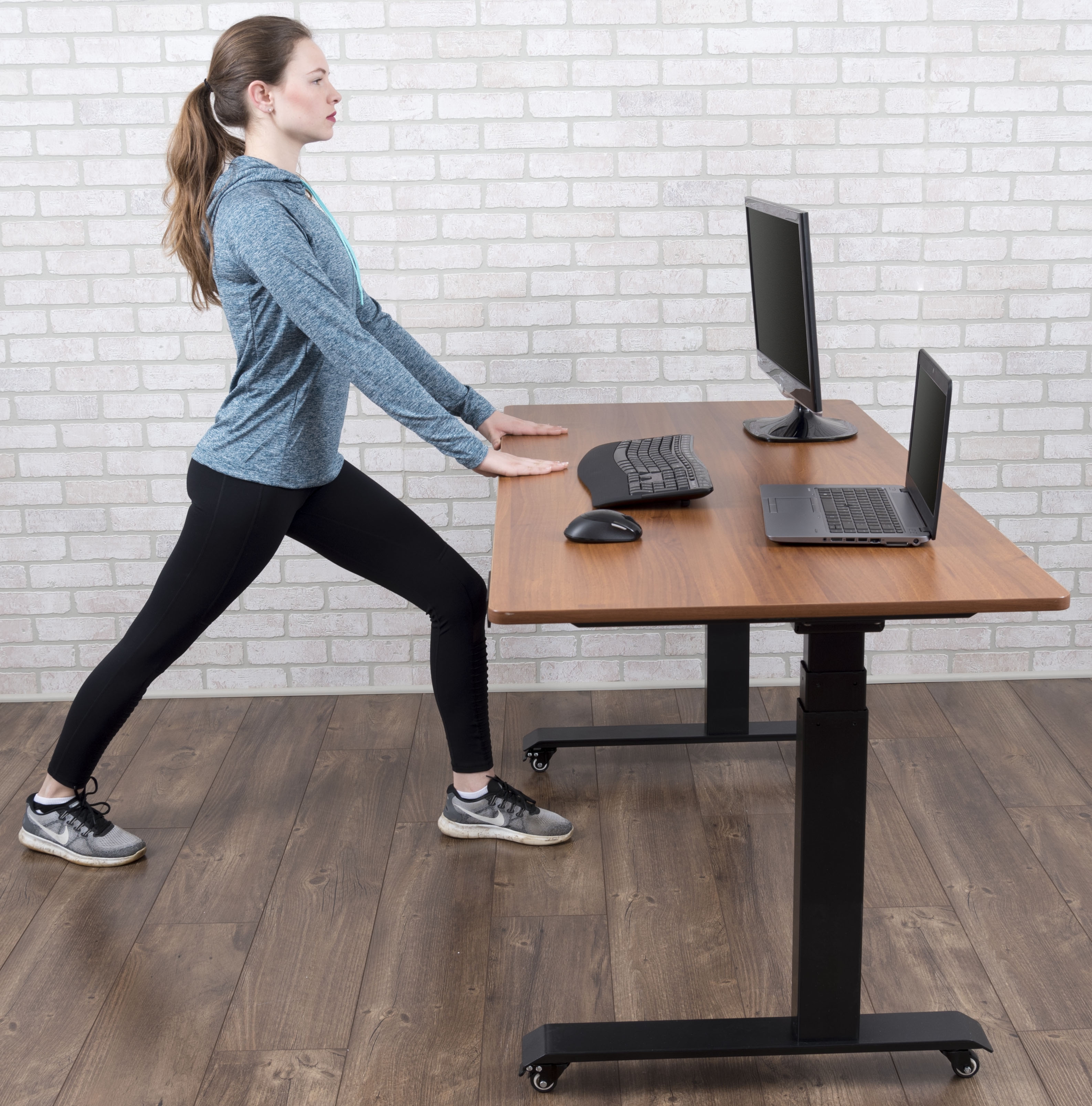
A simple standing desk stretch helps loosen tight hips and legs after long periods of sitting at a computer
4. Seated Hamstring Stretch
While seated, extend one leg forward and place your heel on the floor.
Keep your knee straight and gently lean forward from the hips until you feel a stretch behind the thigh.
Hold for 20–30 seconds and repeat 3 times on each leg.
Benefit: Reduces tightness in the hamstrings from prolonged sitting.
5. Standing Quad Stretch
Stand upright and bend one knee behind you.
Hold your ankle or foot and gently pull your heel towards your buttock.
Keep your knees close together and your body upright.
Hold for 20–30 seconds, repeat 3 times per leg.
Benefit: Opens the front of the thighs and hips.
6. Bodyweight Squats
Stand with feet shoulder-width apart in front of your chair.
Lower your body as if sitting down, then return to standing.
Repeat 10 times, holding the bottom position briefly.
Benefit: Activates large leg muscles and boosts circulation.
7. Standing Hamstring Curls
While standing, bend one knee so your heel moves towards your buttock.
Lower and repeat.
Perform 10 repetitions per leg, holding briefly at the top.
Benefit: Encourages blood flow and activates leg muscles.
Take a Stand for Your Health
Prolonged sitting may be one of the most overlooked workplace health risks today. But the solution is simple:
✔ Stand up regularly
✔ Stretch your muscles
✔ Move for a few minutes every hour
Small movement breaks throughout the day can make a big difference to your long-term health, comfort and productivity.
Break up prolonged sitting — your body will thank you for it.